
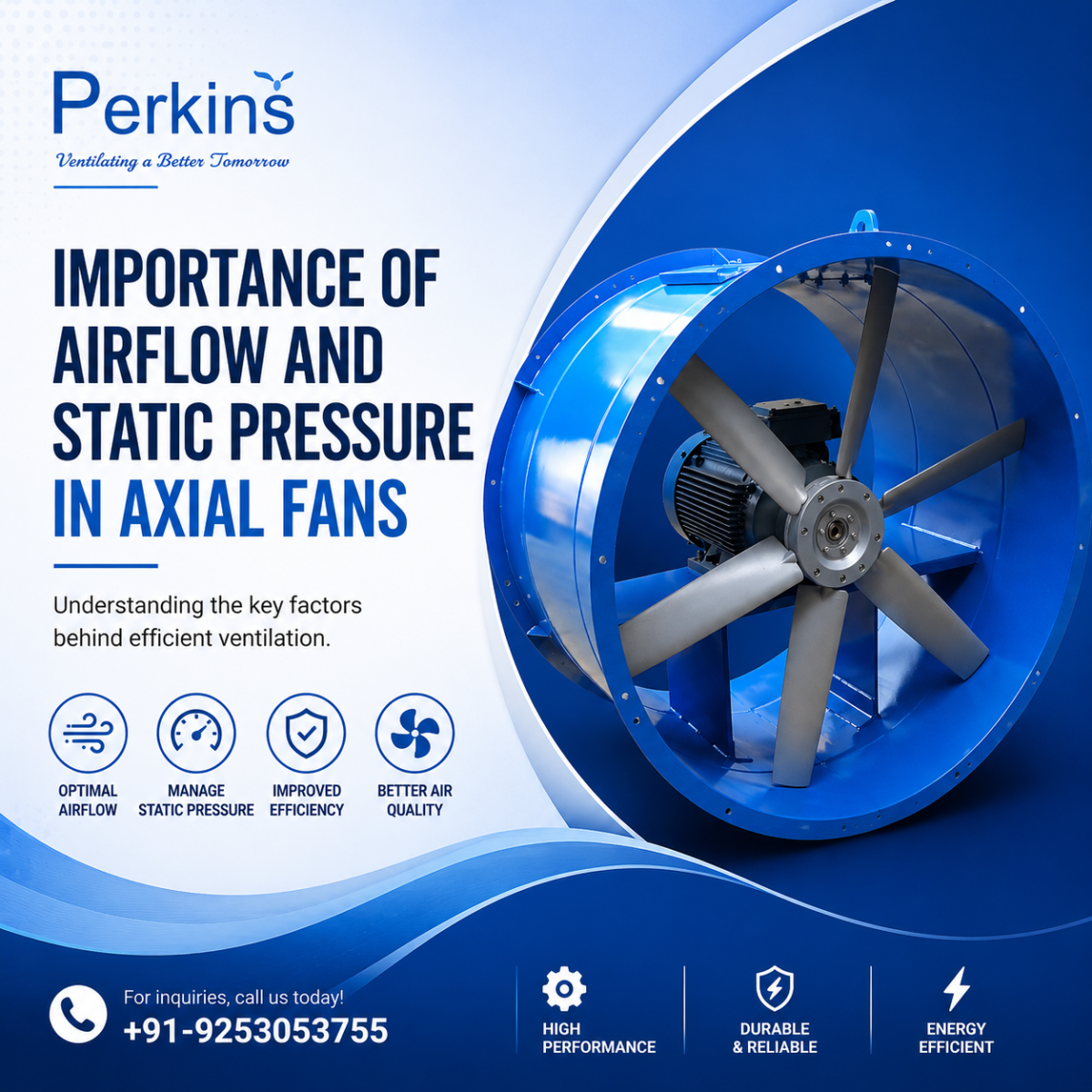
Understanding the Key Factors Behind Efficient Ventilation
In industrial ventilation systems, selecting the right axial fan is critical for achieving optimal airflow, energy efficiency, and workplace comfort. Two of the most important parameters that determine fan performance are airflow and static pressure. Understanding these factors helps industries choose the most suitable fan for their specific applications.
At Perkins Blowers Co., we design and manufacture high-performance axial fans engineered to deliver reliable airflow while meeting the pressure requirements of various industrial environments.
What is Airflow?
Airflow refers to the volume of air moved by a fan within a specific period of time. It is commonly measured in:
- CFM (Cubic Feet per Minute)
- CMH (Cubic Meters per Hour)
The primary purpose of an axial fan is to move large volumes of air efficiently. Adequate airflow is essential for:
- Ventilating industrial facilities
- Removing heat from equipment and processes
- Supplying fresh air to enclosed spaces
- Eliminating fumes, dust, and airborne contaminants
- Maintaining a comfortable working environment
The higher the airflow, the more air the fan can circulate throughout the facility.
What is Static Pressure?
Static pressure is the resistance that the fan must overcome to move air through a ventilation system. This resistance may come from:
- Air ducts
- Filters
- Louvers
- Dampers
- Heat exchangers
- Dust collection equipment
Static pressure is usually measured in millimeters of water gauge (mmWG) or Pascals (Pa).
A ventilation system with longer duct runs, multiple bends, or filtration systems requires higher static pressure to maintain the desired airflow.
Why Airflow and Static Pressure Must Work Together
Many people focus only on airflow when selecting a fan. However, airflow alone does not determine performance.
For example:
A fan may deliver high airflow in an open area, but once connected to a duct system with significant resistance, the actual airflow may decrease substantially if the fan cannot generate sufficient static pressure.
Therefore, selecting a fan requires balancing:
- Required airflow volume
- System static pressure
- Energy consumption
- Operating efficiency
Proper fan selection ensures that the required amount of air reaches its destination without excessive energy usage.
Impact on Industrial Applications
HVAC Ventilation Systems
Buildings require both adequate airflow and pressure to distribute conditioned air effectively throughout the facility.
Manufacturing Plants
Industrial processes generate heat, fumes, and airborne particles that must be removed efficiently through properly sized ventilation systems.
Warehouses and Commercial Spaces
Large spaces depend on high-volume airflow to maintain air quality and employee comfort.
Dust Collection Systems
Air must travel through filters and duct networks, making static pressure a crucial design consideration.
Benefits of Proper Fan Selection
When airflow and static pressure are correctly matched to the application, industries benefit from:
- Improved ventilation performance
- Lower energy consumption
- Increased equipment life
- Reduced maintenance costs
- Better indoor air quality
- Enhanced worker comfort and safety
How Perkins Blowers Co. Can Help
At Perkins Blowers Co., we understand that every ventilation system has unique airflow and pressure requirements. Our team works closely with customers to provide axial fan solutions tailored to their specific applications.
Our axial fans are designed for:
- Industrial ventilation
- HVAC systems
- Exhaust applications
- Fresh air supply systems
- Cooling and process ventilation
- Pollution control systems
With robust construction, reliable performance, and efficient operation, Perkins Blowers Co. continues to deliver ventilation solutions trusted across various industries.
Conclusion
Airflow and static pressure are the foundation of any successful ventilation system. While airflow determines how much air is moved, static pressure determines the fan's ability to overcome system resistance. Understanding the relationship between these two factors ensures better fan selection, improved efficiency, and long-term operational reliability.
When choosing an axial fan, always consider both airflow and static pressure requirements to achieve the best results.