
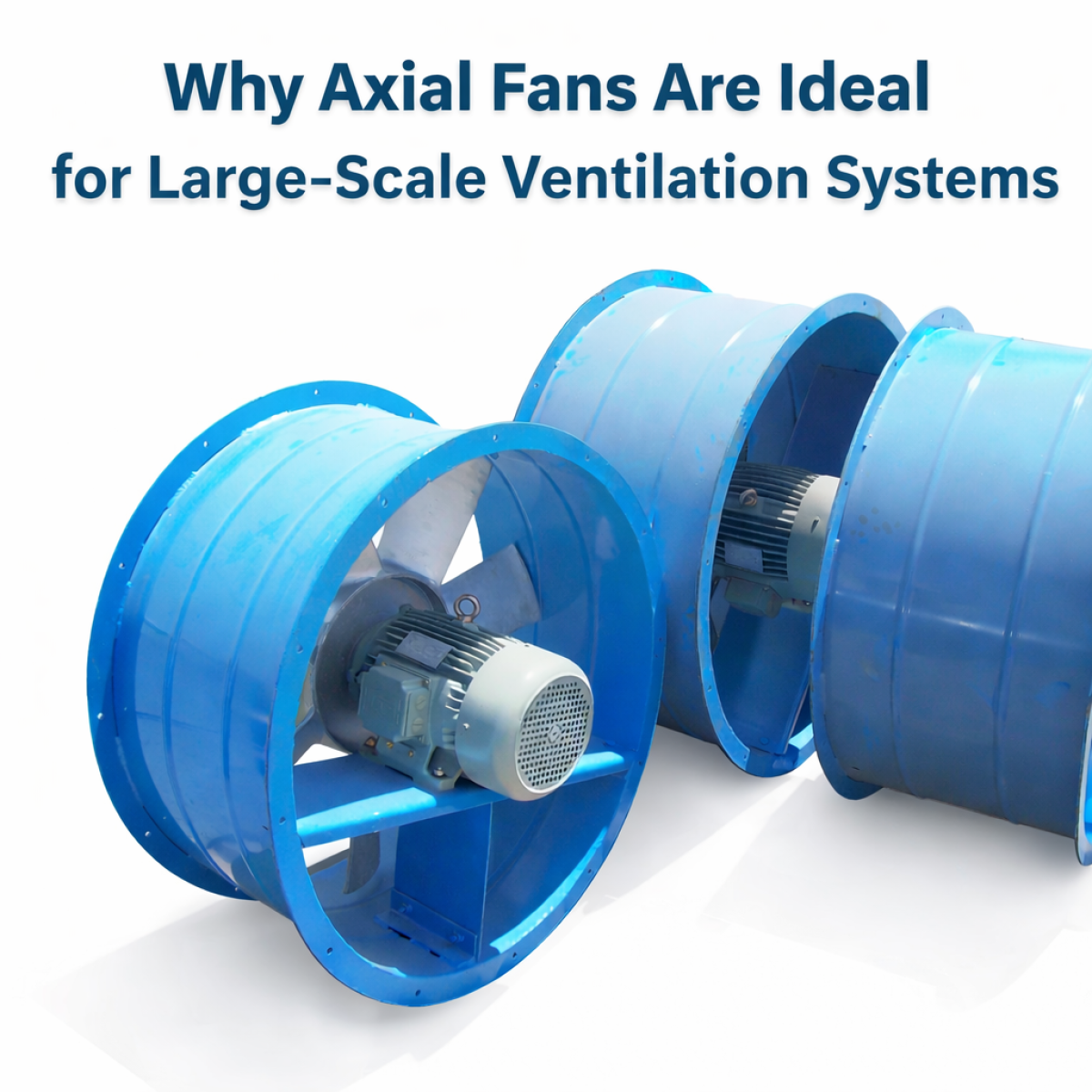
Effective ventilation is a critical requirement in large industrial and commercial spaces such as factories, warehouses, power plants, tunnels, parking areas, and HVAC systems. Among the various airflow solutions available, axial fans stand out as one of the most efficient and practical choices for large-scale ventilation applications.
This blog explores why axial fans are widely preferred and how they deliver reliable performance in high-volume airflow environments.
1. High Airflow Capacity at Low Pressure
Axial fans are specifically designed to move large volumes of air at relatively low static pressure. This makes them ideal for applications where the primary goal is air circulation, heat removal, or fresh air exchange rather than overcoming high resistance.
In large spaces such as warehouses or production halls, axial fans efficiently push air across long distances, ensuring uniform ventilation and temperature control.
2. Energy Efficient Operation
One of the biggest advantages of axial fans is their energy efficiency. Since they move air in a straight, parallel flow to the axis of rotation, they consume less power compared to other fan types when handling high airflow requirements.
This results in:
-
Lower operating costs
-
Reduced energy consumption
-
Improved sustainability for industrial facilities
For continuous ventilation systems, energy efficiency translates directly into long-term cost savings.
3. Compact Design and Easy Installation
Axial fans feature a simple and compact construction, making them easy to install in walls, ducts, ceilings, or rooftops. Their lightweight design reduces structural load and allows flexible mounting options, even in space-constrained areas.
This simplicity also makes axial fans suitable for both new installations and retrofit projects.
4. Versatility Across Applications
Axial fans are highly versatile and are commonly used in:
-
Industrial ventilation systems
-
HVAC air supply and exhaust
-
Cooling towers and heat exchangers
-
Parking garages and tunnels
-
Power plants and substations
They are available in various configurations, including tube axial, vane axial, and wall-mounted designs, allowing customization based on airflow and installation requirements.
5. Low Noise Levels with Proper Design
Modern axial fans are engineered with aerodynamic blades and balanced rotors to minimize noise and vibration. When properly selected and installed, they offer quiet operation even at high airflow rates—an important factor in commercial buildings and occupied industrial environments.
6. Durable and Low Maintenance
Axial fans are built for continuous operation and harsh industrial conditions. With fewer moving parts and robust construction materials such as steel or aluminum, they require minimal maintenance and deliver long service life.
This reliability makes them ideal for facilities where downtime can be costly.
7. Cost-Effective Solution for Large Spaces
Compared to other ventilation systems, axial fans provide an excellent balance between performance and cost. Their lower initial investment, combined with energy-efficient operation and minimal maintenance, makes them a cost-effective choice for large-scale ventilation projects.
Conclusion
Axial fans are an ideal solution for large-scale ventilation systems due to their high airflow capacity, energy efficiency, compact design, and operational reliability. Whether for industrial plants, commercial buildings, or infrastructure projects, axial fans ensure effective air movement while keeping operating costs under control.
By choosing the right axial fan design and specifications, industries can achieve optimal ventilation performance tailored to their specific needs.